Smart Universities Walk the Talk of Commitment
DOI:
https://doi.org/10.37870/joqie.v7i9.9Keywords:
Smart City, Smart University, breakthrough, quality paradigms, commitment paradigmAbstract
Twenty first century cities encounter many problems regarding transportation, governance, information technology, environment, resources. Smart cities are needed and already booming all over the world. The concept of Smart Cities needs to be defined. The Smart City model by Giffinger et al (2007) is useful in this respect. It discerns six topics: smart living, smart governance, smart economy, smart mobility, smart environment and smart people.
This article focuses on the consequences of smart cities for universities. They can teach their students specific competences in e.g. Information Technology, Urbanisation, Smart Cities and Sustainability. They can do research in such areas. But: "The centrality of "žsmart citizens"Ÿ, rather than "žsmart cities"Ÿ, can be easily overlooked." (Slovava and Okwechime, 2016). Smart Cities can only function, if their citizen become smart. For universities that means teaching general competences to all students like problem solving, creativity, flexibility and critical thinking. Crucial is knowledge and skills regarding sustainability. For that matter, the university will need to be an example to be credible.
Actually, universities need a paradigm shift: from control and continuous improvement to commitment, a preliminary stage to real breakthrough. The stage the university is in can be measured with the Emergency Model (c) (Van Kemenade, 2017). The instrument can also point out what still needs to be done to achieve the breakthrough that is needed for universities in times of Smart Cities.
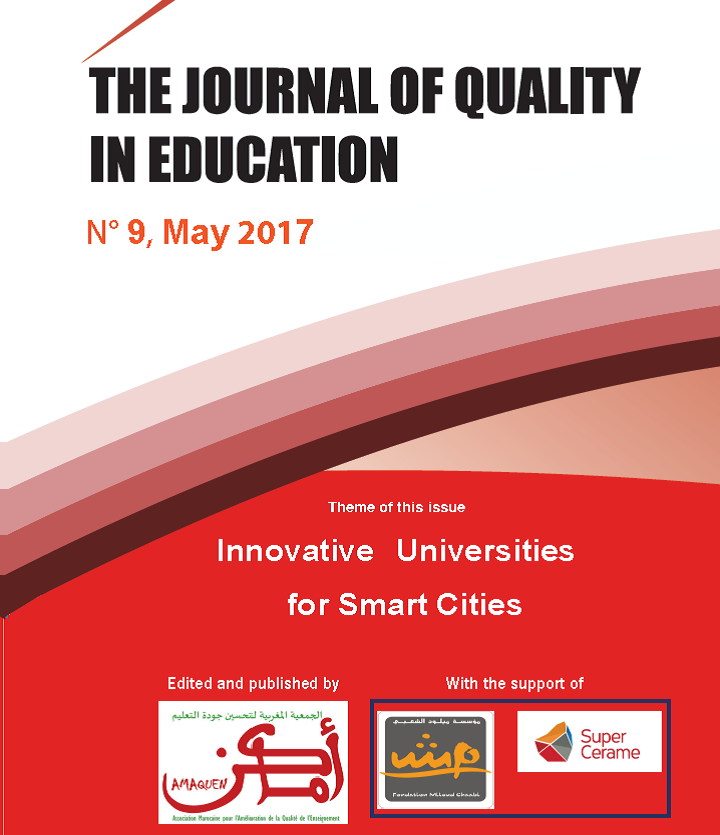
Downloads
Published
Issue
Section
License
Copyright (c) 2017 The Journal of Quality in Education

This work is licensed under a Creative Commons Attribution-NonCommercial-ShareAlike 4.0 International License.
Authors who publish with this journal agree to the following terms:
- Authors retain copyright and grant the journal right of first publication with the work simultaneously licensed under a Creative Commons Attribution License that allows others to share the work with an acknowledgement of the work's authorship and initial publication in this journal.
- Authors are able to enter into separate, additional contractual arrangements for the non-exclusive distribution of the journal's published version of the work (e.g., post it to an institutional repository or publish it in a book), with an acknowledgement of its initial publication in this journal.
- Authors are permitted and encouraged to post their work online (e.g., in institutional repositories or on their website) prior to and during the submission process, as it can lead to productive exchanges, as well as earlier and greater citation of published work.